


We will now present formulae for calculating  ,
,  and
and  . We do this by expanding (
 ) and
() in the
) and
() in the  and
and  basis (zeroth order basis) with the following definition:

We now define an operator  so that

where  is the projection onto the orthogonal
complement of
is the projection onto the orthogonal
complement of  . In other words, if
the domain of
. In other words, if
the domain of  is restricted to make
  one to one, then
  is the
inverse of
is the
inverse of  .
.
By applying  on equation (), the
multipole functions can be generated according to
on equation (), the
multipole functions can be generated according to

Or expressed in the zeroth order basis for  ,
,


where

are the matrix elements of the operator  , and
, and

are the eigenvalues of 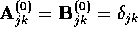 .
.
These relations will generate the multipole functions from the
seeds  . If
. If
 then
then  and
and
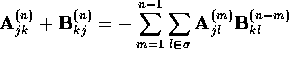 may be chosen arbitrarily subject to

To complete the prescription, we need a formula for calculating
the  , and we also need to
check that the biorthonormality condition ()
is satisfied in the case
, and we also need to
check that the biorthonormality condition ()
is satisfied in the case 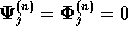 .
For convenience of notation, we will define
.
For convenience of notation, we will define

for every n less than zero. This means that all the power series expansions hold for every integer n.
From (),

Expanding this in powers of  , one gets

The second term can be expressed as
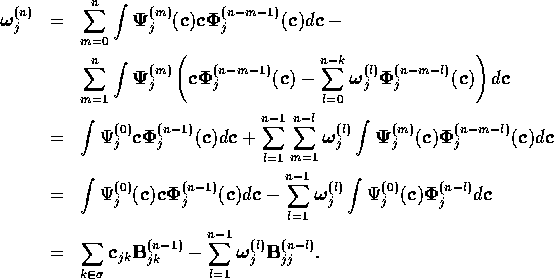
The second two terms vanish because of the biorthonormality
condition () and the eigenvalue equation
(). The final step is to evaluate this
equation by the recursion equation ():

A similar calculation using the adjoint equation gives an
alternative formula for 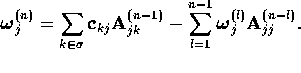 .
.

Thus the problem has been reduced to evaluating the matrix
element  .
.
For example, if the spectrum of  is non-degenerate,
the first few coefficients of the recursion series are
is non-degenerate,
the first few coefficients of the recursion series are



In this case, the arbitrary additive terms are proportional to
 . The rank n tensors
  are the coefficients of these terms, and may be chosen to be zero.

